
Negosyo Advocates
Negosyo Advocates is a duly registered non-stock, non-profit network of entrepreneurs and advocates committed to advancing national industrialization and economic patriotism.
The organization brings together business leaders, sectoral groups, and policy advocates to strengthen domestic industries, support SMEs, and promote a self-reliant Philippine economy through coordinated advocacy, education, and collective action.
The organization brings together business leaders, sectoral groups, and policy advocates to strengthen domestic industries, support SMEs, and promote a self-reliant Philippine economy through coordinated advocacy, education, and collective action.
The Case for National Industrialization
The Philippine economy remains heavily dependent on foreign imports across critical sectors, including food, energy, pharmaceuticals, capital goods, and industrial raw materials. While global trade has expanded market access, it has also deepened structural vulnerabilities within domestic industries.
Many of the country’s leading export sectors function primarily as assembly hubs reliant on imported components rather than as vertically integrated producers utilizing local resources. This limits value creation, weakens domestic supply chains, and exposes the nation to external economic shocks.
Decades of policy frameworks favoring liberalization over sustained industrial development have contributed to the marginalization of local manufacturing and agro-industrial sectors. Small and medium enterprises continue to face systemic challenges in taxation, production costs, financing access, and regulatory complexity.
National industrialization is therefore not simply an economic aspiration—it is a strategic imperative. Rebuilding domestic productive capacity is essential to strengthening resilience, advancing economic sovereignty, and securing long-term national development.
Many of the country’s leading export sectors function primarily as assembly hubs reliant on imported components rather than as vertically integrated producers utilizing local resources. This limits value creation, weakens domestic supply chains, and exposes the nation to external economic shocks.
Decades of policy frameworks favoring liberalization over sustained industrial development have contributed to the marginalization of local manufacturing and agro-industrial sectors. Small and medium enterprises continue to face systemic challenges in taxation, production costs, financing access, and regulatory complexity.
National industrialization is therefore not simply an economic aspiration—it is a strategic imperative. Rebuilding domestic productive capacity is essential to strengthening resilience, advancing economic sovereignty, and securing long-term national development.
The Path Forward: Coordinated National Action
Rebuilding the Philippine industrial base requires more than isolated efforts. It demands coordinated, multi-stakeholder action grounded in evidence-based policy and long-term national interest.
Negosyo Advocates unites entrepreneurs, industry leaders, academics, sectoral groups, and policy advocates to advance strategic protection, promotion, and development initiatives that strengthen domestic industries. This approach seeks to rebalance an economy currently structured around foreign supply chains and restore priority to sovereign productive capacity.
Industrialization must serve both domestic needs and global opportunities. By aligning business communities around shared objectives—investment in local manufacturing, agro-industrial development, technology transfer, workforce upskilling, and regulatory reform—Negosyo Advocates helps build a resilient economic foundation rooted in Philippine realities.
The task is urgent. National resilience depends on restoring productive capacity, strengthening SMEs, and ensuring that economic growth translates into long-term sovereignty and stability.
Negosyo Advocates unites entrepreneurs, industry leaders, academics, sectoral groups, and policy advocates to advance strategic protection, promotion, and development initiatives that strengthen domestic industries. This approach seeks to rebalance an economy currently structured around foreign supply chains and restore priority to sovereign productive capacity.
Industrialization must serve both domestic needs and global opportunities. By aligning business communities around shared objectives—investment in local manufacturing, agro-industrial development, technology transfer, workforce upskilling, and regulatory reform—Negosyo Advocates helps build a resilient economic foundation rooted in Philippine realities.
The task is urgent. National resilience depends on restoring productive capacity, strengthening SMEs, and ensuring that economic growth translates into long-term sovereignty and stability.
Membership & Governance Structure
Negosyo Advocates is a voluntary and open network composed of business organizations, industry associations, entrepreneurs, and like-minded individuals committed to advancing economic patriotism and national industrialization.
The organization is governed by a Board of Directors composed of industry leaders and subject-matter experts who guide strategic direction and advocacy priorities. Advisors provide specialized expertise, while day-to-day operations are managed by a Secretariat led by a National Coordinator, ensuring alignment between policy direction and operational execution.
Members convene annually through the National Conference to review plans, strengthen solidarity, and participate in coordinated initiatives. Specialized clusters allow focused engagement in priority sectors such as food industry and cooperatives, enabling targeted programs while maintaining alignment with the network’s broader objectives.
This structured yet flexible governance model ensures that Negosyo Advocates remains a disciplined, member-driven platform capable of sustained national-level advocacy.
The organization is governed by a Board of Directors composed of industry leaders and subject-matter experts who guide strategic direction and advocacy priorities. Advisors provide specialized expertise, while day-to-day operations are managed by a Secretariat led by a National Coordinator, ensuring alignment between policy direction and operational execution.
Members convene annually through the National Conference to review plans, strengthen solidarity, and participate in coordinated initiatives. Specialized clusters allow focused engagement in priority sectors such as food industry and cooperatives, enabling targeted programs while maintaining alignment with the network’s broader objectives.
This structured yet flexible governance model ensures that Negosyo Advocates remains a disciplined, member-driven platform capable of sustained national-level advocacy.

Negosyo Advocates Holds Solar 101 Forum on Renewable Energy and Climate Action
Negosyo Advocates successfully held the forum, "Solar 101 and Our Climate Changing Climate: Why Is It Urgent to Shift to Renewable Energy?" on June 26, 2026, at the WeGen Energy PH Office. The event brought together business owners, MSMEs, professionals, and advocates to discuss practical renewable energy solutions and the urgent need to address the country's energy and climate challenges.
The forum highlighted how rising electricity costs, increasing fuel prices, and climate change affect businesses and communities. Participants learned how rooftop solar systems can help reduce electricity expenses, improve energy security, and provide greater resilience during power interruptions. Speakers also emphasized the importance of collaboration between the private sector and communities in advancing renewable energy initiatives.
Prof. Gani Tapang of the University of the Philippines discussed the country's continuing energy crisis, emphasizing the need for renewable energy to support national industrialization, strengthen local industries, create quality jobs, and improve the welfare of Filipino communities.
Ina Silverio, Social Transformation Manager of WeGen, highlighted the connection between renewable energy and climate action. She encouraged the adoption of rooftop solar systems to reduce carbon emissions, build climate resilience, and ensure that renewable energy projects benefit communities while protecting the rights of farmers, fisherfolk, and indigenous peoples.
Ron Magbuhos, Head of the Energy Cluster of Negosyo Advocates, discussed the opportunities and challenges faced by MSMEs in adopting solar energy, citing high installation costs, limited financing, and lack of technical knowledge. He called for stronger government support, improved financing programs, and greater collaboration to help more businesses transition to renewable energy.
The forum concluded with a call for collective action, emphasizing that the country's energy transition should not only expand the use of clean energy but also make electricity more affordable and reliable, strengthen Filipino businesses, protect the environment, and improve the lives of communities while supporting national industrialization.
The forum highlighted how rising electricity costs, increasing fuel prices, and climate change affect businesses and communities. Participants learned how rooftop solar systems can help reduce electricity expenses, improve energy security, and provide greater resilience during power interruptions. Speakers also emphasized the importance of collaboration between the private sector and communities in advancing renewable energy initiatives.
Prof. Gani Tapang of the University of the Philippines discussed the country's continuing energy crisis, emphasizing the need for renewable energy to support national industrialization, strengthen local industries, create quality jobs, and improve the welfare of Filipino communities.
Ina Silverio, Social Transformation Manager of WeGen, highlighted the connection between renewable energy and climate action. She encouraged the adoption of rooftop solar systems to reduce carbon emissions, build climate resilience, and ensure that renewable energy projects benefit communities while protecting the rights of farmers, fisherfolk, and indigenous peoples.
Ron Magbuhos, Head of the Energy Cluster of Negosyo Advocates, discussed the opportunities and challenges faced by MSMEs in adopting solar energy, citing high installation costs, limited financing, and lack of technical knowledge. He called for stronger government support, improved financing programs, and greater collaboration to help more businesses transition to renewable energy.
The forum concluded with a call for collective action, emphasizing that the country's energy transition should not only expand the use of clean energy but also make electricity more affordable and reliable, strengthen Filipino businesses, protect the environment, and improve the lives of communities while supporting national industrialization.
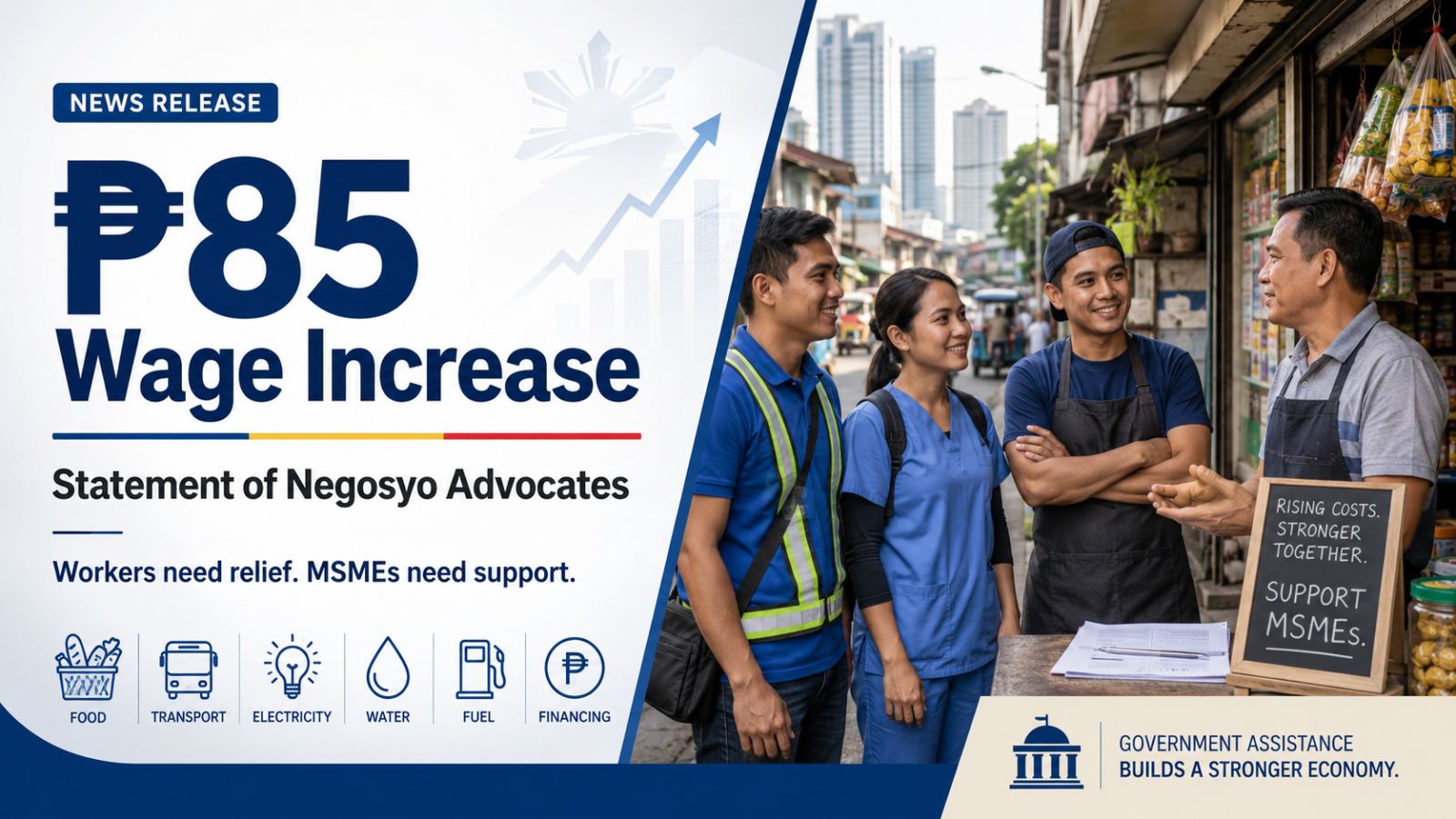
Statement of Negosyo Advocates on the ₱85 wage increase
With the continuing rise in the prices of food, transportation, electricity, water, and other basic necessities, an increase in the minimum wage is justified and provides much-needed relief to Filipino workers and their families. While the adjustment may not be enough to fully address the rising cost of living, it is a reasonable step toward helping workers cope with today's economic challenges.
At the same time, enterprises, especially micro, small, and medium enterprises (MSMEs), cannot carry this responsibility alone. Many MSMEs are already struggling with rising electricity rates, high fuel costs, expensive raw materials, increasing rent, national and local taxes, and other operating expenses. These businesses want to provide better wages and better jobs, but they also need support to remain open and keep their workers employed.
We therefore call on the government to step up and help MSMEs, which employ the majority of Filipino workers. Government assistance should include financial support for small businesses, relief from national and local taxes, lower electricity costs, affordable financing, and stronger measures to control the prices of fuel, raw materials, and other business inputs. These actions will help MSMEs absorb the wage increase while protecting jobs, sustaining business operations, and preserving employment.
Supporting workers and supporting MSMEs should go hand in hand. A fair wage policy must be matched with strong government support for enterprises. Only through this shared responsibility can we improve the lives of workers, help businesses grow, and build a stronger and more resilient Philippine economy.
At the same time, enterprises, especially micro, small, and medium enterprises (MSMEs), cannot carry this responsibility alone. Many MSMEs are already struggling with rising electricity rates, high fuel costs, expensive raw materials, increasing rent, national and local taxes, and other operating expenses. These businesses want to provide better wages and better jobs, but they also need support to remain open and keep their workers employed.
We therefore call on the government to step up and help MSMEs, which employ the majority of Filipino workers. Government assistance should include financial support for small businesses, relief from national and local taxes, lower electricity costs, affordable financing, and stronger measures to control the prices of fuel, raw materials, and other business inputs. These actions will help MSMEs absorb the wage increase while protecting jobs, sustaining business operations, and preserving employment.
Supporting workers and supporting MSMEs should go hand in hand. A fair wage policy must be matched with strong government support for enterprises. Only through this shared responsibility can we improve the lives of workers, help businesses grow, and build a stronger and more resilient Philippine economy.
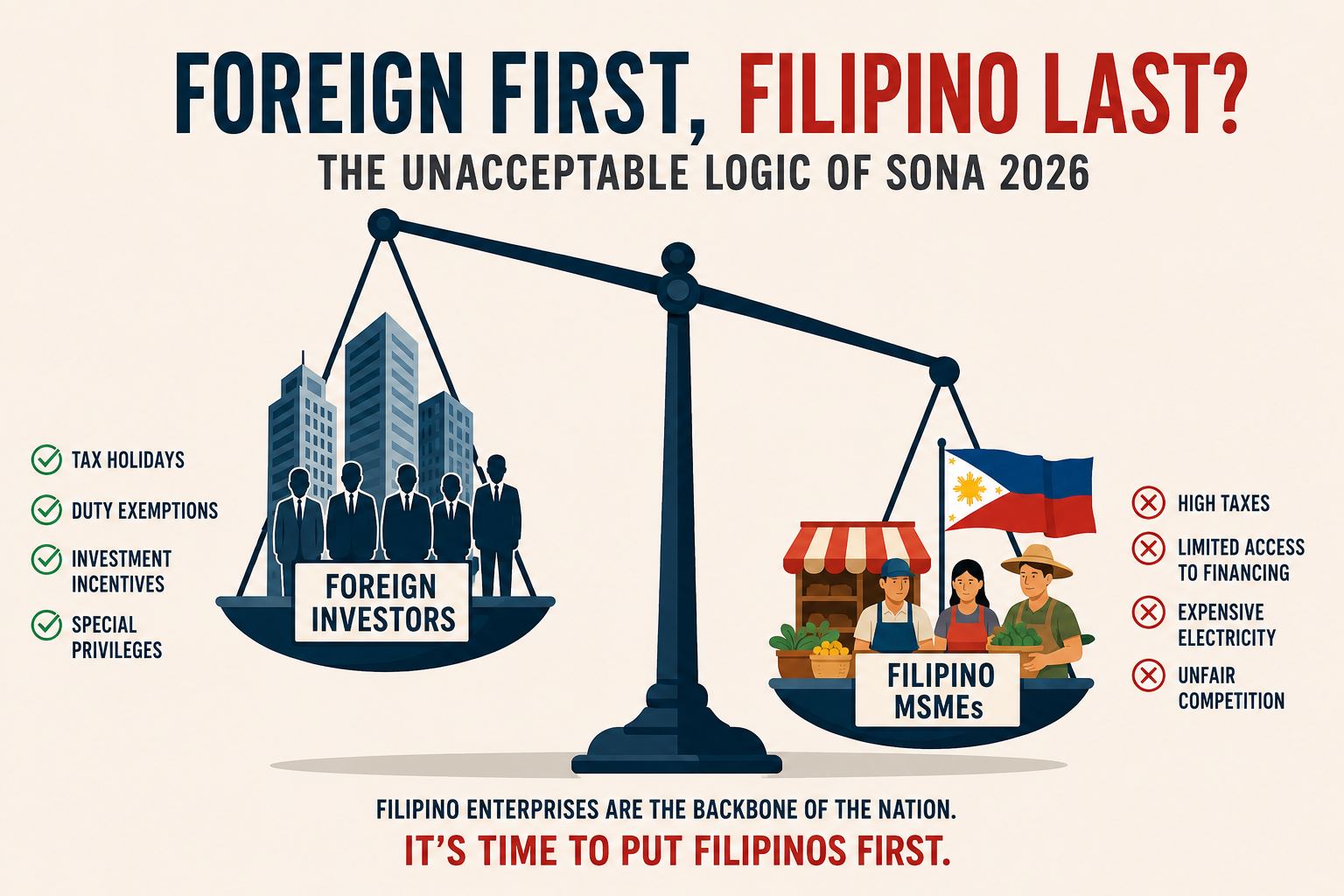
𝐅𝐎𝐑𝐄𝐈𝐆𝐍 𝐅𝐈𝐑𝐒𝐓, 𝐅𝐈𝐋𝐈𝐏𝐈𝐍𝐎 𝐋𝐀𝐒𝐓? 𝐓𝐡𝐞 𝐔𝐧𝐚𝐜𝐜𝐞𝐩𝐭𝐚𝐛𝐥𝐞 𝐋𝐨𝐠𝐢𝐜 𝐨𝐟 𝐒𝐎𝐍𝐀 𝟐𝟎𝟐𝟔
In his 2026 State of the Nation Address, President Ferdinand “Bongbong” Marcos Jr. acknowledged the struggles of micro-entrepreneurs and offered tax relief and measures to ease electricity costs. We at Negosyo Advocates see no genuine effort to lighten the burden on small businesses.
Let us be clear: They do not address the root of the crisis. While Filipino MSMEs are offered crumbs, the administration continues to roll out a red carpet for foreign corporations through generous tax holidays, duty exemptions, and investment incentives. This is not merely an imbalance—it is a profound policy contradiction that places foreign capital on a pedestal while leaving Filipino entrepreneurs to fend for themselves in an uneven playing field.
𝐓𝐡𝐢𝐬 𝐢𝐬 𝐧𝐨𝐭 𝐟𝐚𝐢𝐫, 𝐚𝐧𝐝 𝐦𝐨𝐫𝐞 𝐢𝐦𝐩𝐨𝐫𝐭𝐚𝐧𝐭𝐥𝐲, 𝐢𝐭 𝐢𝐬 𝐧𝐨𝐭 𝐬𝐭𝐫𝐚𝐭𝐞𝐠𝐢𝐜.
If the government is truly sincere about empowering MSMEs, it must surpass The level of support extended to foreign investors. Filipino-owned enterprises should not be treated as second-class economic actors in their own homeland. They are the backbone of local employment, the lifeblood of rural economies, and the primary drivers of inclusive growth. Yet they are being systematically disadvantaged by a policy regime that rewards external players over domestic producers.
Negosyo Advocates firmly asserts that foreign investment must not supplant the development of Filipino enterprise. We reject a model where local industries are sacrificed at the altar of short-term foreign inflows. A strategy would place Filipino MSMEs at the core, with foreign investments playing a role that transfers technology, builds capacity, and integrates with local supply chains. Instead, we are seeing displacement.
The absence of a coherent national industrialization program is the elephant in the room. Without a clear roadmap to strengthen domestic manufacturing, agri-processing, and value-adding activities, MSMEs will continue to be crushed by large foreign competitors that enjoy superior economies of scale and state-backed privileges. This is not competition—it is subjugation.
Our concern deepens with the government’s continued over-reliance on agricultural imports, particularly rice. While imports may temporarily plug supply gaps, the long-term cost is devastating: local farmers are undercut, farm incomes collapse, and domestic production stagnates. This ripple effect directly harms MSMEs that depend on local agricultural raw materials for processing, packaging, and trade. Instead of treating imports as a permanent crutch, the government should aggressively invest in farm productivity, post-harvest infrastructure, and rural credit—so that Filipino farmers and food entrepreneurs can compete and thrive.
Taken together, these policies send an unmistakable signal: foreign investors and imported goods are prioritized over Filipino producers. The message to every small business owner, farmer, and cooperativemember is clear—you are expendable.
𝐍𝐞𝐠𝐨𝐬𝐲𝐨 𝐀𝐝𝐯𝐨𝐜𝐚𝐭𝐞𝐬 𝐫𝐞𝐣𝐞𝐜𝐭𝐬 𝐭𝐡𝐢𝐬 𝐭𝐫𝐚𝐣𝐞𝐜𝐭𝐨𝐫𝐲. We demand that national economic policy give greater weight to MSMEs, cooperatives, farmers, and local manufacturers. Filipino enterprises must be placed at the very center of the country's development strategy—not as an afterthought, but as the engine of national resilience. They are the ones who create jobs in every barangay, sustain local supply chains, and build a self-reliant, productive economy that can weather global shocks.
𝐖𝐞 𝐜𝐚𝐥𝐥 𝐨𝐧 𝐭𝐡𝐞 𝐚𝐝𝐦𝐢𝐧𝐢𝐬𝐭𝐫𝐚𝐭𝐢𝐨𝐧 𝐭𝐨 𝐫𝐞𝐜𝐚𝐥𝐢𝐛𝐫𝐚𝐭𝐞 𝐢𝐭𝐬 𝐩𝐫𝐢𝐨𝐫𝐢𝐭𝐢𝐞𝐬—𝐧𝐨𝐭 𝐰𝐢𝐭𝐡 𝐫𝐡𝐞𝐭𝐨𝐫𝐢𝐜, 𝐛𝐮𝐭 𝐰𝐢𝐭𝐡 𝐫𝐞𝐬𝐨𝐮𝐫𝐜𝐞𝐬, 𝐩𝐨𝐥𝐢𝐜𝐲 𝐫𝐞𝐟𝐨𝐫𝐦, 𝐚𝐧𝐝 𝐩𝐨𝐥𝐢𝐭𝐢𝐜𝐚𝐥 𝐰𝐢𝐥𝐥. 𝐓𝐡𝐞 𝐟𝐮𝐭𝐮𝐫𝐞 𝐨𝐟 𝐏𝐡𝐢𝐥𝐢𝐩𝐩𝐢𝐧𝐞 𝐢𝐧𝐝𝐮𝐬𝐭𝐫𝐢𝐚𝐥𝐢𝐳𝐚𝐭𝐢𝐨𝐧 𝐝𝐞𝐩𝐞𝐧𝐝𝐬 𝐨𝐧 𝐰𝐡𝐞𝐭𝐡𝐞𝐫 𝐰𝐞 𝐞𝐦𝐩𝐨𝐰𝐞𝐫 𝐨𝐮𝐫 𝐨𝐰𝐧 𝐩𝐞𝐨𝐩𝐥𝐞 𝐟𝐢𝐫𝐬𝐭. 𝐀𝐧𝐲𝐭𝐡𝐢𝐧𝐠 𝐥𝐞𝐬𝐬 𝐢𝐬 𝐧𝐨𝐭 𝐣𝐮𝐬𝐭 𝐮𝐧𝐟𝐚𝐢𝐫—𝐢𝐭 𝐢𝐬 𝐚 𝐛𝐞𝐭𝐫𝐚𝐲𝐚𝐥 𝐨𝐟 𝐭𝐡𝐞 𝐯𝐞𝐫𝐲 𝐟𝐨𝐮𝐧𝐝𝐚𝐭𝐢𝐨𝐧𝐬 𝐨𝐟 𝐨𝐮𝐫 𝐧𝐚𝐭𝐢𝐨𝐧'𝐬 𝐞𝐜𝐨𝐧𝐨𝐦𝐢𝐜 𝐬𝐨𝐯𝐞𝐫𝐞𝐢𝐠𝐧𝐭𝐲.
Let us be clear: They do not address the root of the crisis. While Filipino MSMEs are offered crumbs, the administration continues to roll out a red carpet for foreign corporations through generous tax holidays, duty exemptions, and investment incentives. This is not merely an imbalance—it is a profound policy contradiction that places foreign capital on a pedestal while leaving Filipino entrepreneurs to fend for themselves in an uneven playing field.
𝐓𝐡𝐢𝐬 𝐢𝐬 𝐧𝐨𝐭 𝐟𝐚𝐢𝐫, 𝐚𝐧𝐝 𝐦𝐨𝐫𝐞 𝐢𝐦𝐩𝐨𝐫𝐭𝐚𝐧𝐭𝐥𝐲, 𝐢𝐭 𝐢𝐬 𝐧𝐨𝐭 𝐬𝐭𝐫𝐚𝐭𝐞𝐠𝐢𝐜.
If the government is truly sincere about empowering MSMEs, it must surpass The level of support extended to foreign investors. Filipino-owned enterprises should not be treated as second-class economic actors in their own homeland. They are the backbone of local employment, the lifeblood of rural economies, and the primary drivers of inclusive growth. Yet they are being systematically disadvantaged by a policy regime that rewards external players over domestic producers.
Negosyo Advocates firmly asserts that foreign investment must not supplant the development of Filipino enterprise. We reject a model where local industries are sacrificed at the altar of short-term foreign inflows. A strategy would place Filipino MSMEs at the core, with foreign investments playing a role that transfers technology, builds capacity, and integrates with local supply chains. Instead, we are seeing displacement.
The absence of a coherent national industrialization program is the elephant in the room. Without a clear roadmap to strengthen domestic manufacturing, agri-processing, and value-adding activities, MSMEs will continue to be crushed by large foreign competitors that enjoy superior economies of scale and state-backed privileges. This is not competition—it is subjugation.
Our concern deepens with the government’s continued over-reliance on agricultural imports, particularly rice. While imports may temporarily plug supply gaps, the long-term cost is devastating: local farmers are undercut, farm incomes collapse, and domestic production stagnates. This ripple effect directly harms MSMEs that depend on local agricultural raw materials for processing, packaging, and trade. Instead of treating imports as a permanent crutch, the government should aggressively invest in farm productivity, post-harvest infrastructure, and rural credit—so that Filipino farmers and food entrepreneurs can compete and thrive.
Taken together, these policies send an unmistakable signal: foreign investors and imported goods are prioritized over Filipino producers. The message to every small business owner, farmer, and cooperativemember is clear—you are expendable.
𝐍𝐞𝐠𝐨𝐬𝐲𝐨 𝐀𝐝𝐯𝐨𝐜𝐚𝐭𝐞𝐬 𝐫𝐞𝐣𝐞𝐜𝐭𝐬 𝐭𝐡𝐢𝐬 𝐭𝐫𝐚𝐣𝐞𝐜𝐭𝐨𝐫𝐲. We demand that national economic policy give greater weight to MSMEs, cooperatives, farmers, and local manufacturers. Filipino enterprises must be placed at the very center of the country's development strategy—not as an afterthought, but as the engine of national resilience. They are the ones who create jobs in every barangay, sustain local supply chains, and build a self-reliant, productive economy that can weather global shocks.
𝐖𝐞 𝐜𝐚𝐥𝐥 𝐨𝐧 𝐭𝐡𝐞 𝐚𝐝𝐦𝐢𝐧𝐢𝐬𝐭𝐫𝐚𝐭𝐢𝐨𝐧 𝐭𝐨 𝐫𝐞𝐜𝐚𝐥𝐢𝐛𝐫𝐚𝐭𝐞 𝐢𝐭𝐬 𝐩𝐫𝐢𝐨𝐫𝐢𝐭𝐢𝐞𝐬—𝐧𝐨𝐭 𝐰𝐢𝐭𝐡 𝐫𝐡𝐞𝐭𝐨𝐫𝐢𝐜, 𝐛𝐮𝐭 𝐰𝐢𝐭𝐡 𝐫𝐞𝐬𝐨𝐮𝐫𝐜𝐞𝐬, 𝐩𝐨𝐥𝐢𝐜𝐲 𝐫𝐞𝐟𝐨𝐫𝐦, 𝐚𝐧𝐝 𝐩𝐨𝐥𝐢𝐭𝐢𝐜𝐚𝐥 𝐰𝐢𝐥𝐥. 𝐓𝐡𝐞 𝐟𝐮𝐭𝐮𝐫𝐞 𝐨𝐟 𝐏𝐡𝐢𝐥𝐢𝐩𝐩𝐢𝐧𝐞 𝐢𝐧𝐝𝐮𝐬𝐭𝐫𝐢𝐚𝐥𝐢𝐳𝐚𝐭𝐢𝐨𝐧 𝐝𝐞𝐩𝐞𝐧𝐝𝐬 𝐨𝐧 𝐰𝐡𝐞𝐭𝐡𝐞𝐫 𝐰𝐞 𝐞𝐦𝐩𝐨𝐰𝐞𝐫 𝐨𝐮𝐫 𝐨𝐰𝐧 𝐩𝐞𝐨𝐩𝐥𝐞 𝐟𝐢𝐫𝐬𝐭. 𝐀𝐧𝐲𝐭𝐡𝐢𝐧𝐠 𝐥𝐞𝐬𝐬 𝐢𝐬 𝐧𝐨𝐭 𝐣𝐮𝐬𝐭 𝐮𝐧𝐟𝐚𝐢𝐫—𝐢𝐭 𝐢𝐬 𝐚 𝐛𝐞𝐭𝐫𝐚𝐲𝐚𝐥 𝐨𝐟 𝐭𝐡𝐞 𝐯𝐞𝐫𝐲 𝐟𝐨𝐮𝐧𝐝𝐚𝐭𝐢𝐨𝐧𝐬 𝐨𝐟 𝐨𝐮𝐫 𝐧𝐚𝐭𝐢𝐨𝐧'𝐬 𝐞𝐜𝐨𝐧𝐨𝐦𝐢𝐜 𝐬𝐨𝐯𝐞𝐫𝐞𝐢𝐠𝐧𝐭𝐲.